There is a Bengali word that has no clean equivalent in English. The word is “Adda,” and it roughly translates to an informal, freewheeling conversation among friends or acquaintances, usually held in a relaxed setting with no fixed agenda. Adda is not small talk. It is not networking. It is not a meeting. It is something older and more generous than all of those. And in Kolkata, Adda is almost always accompanied by chai.
What Adda Actually Looks Like
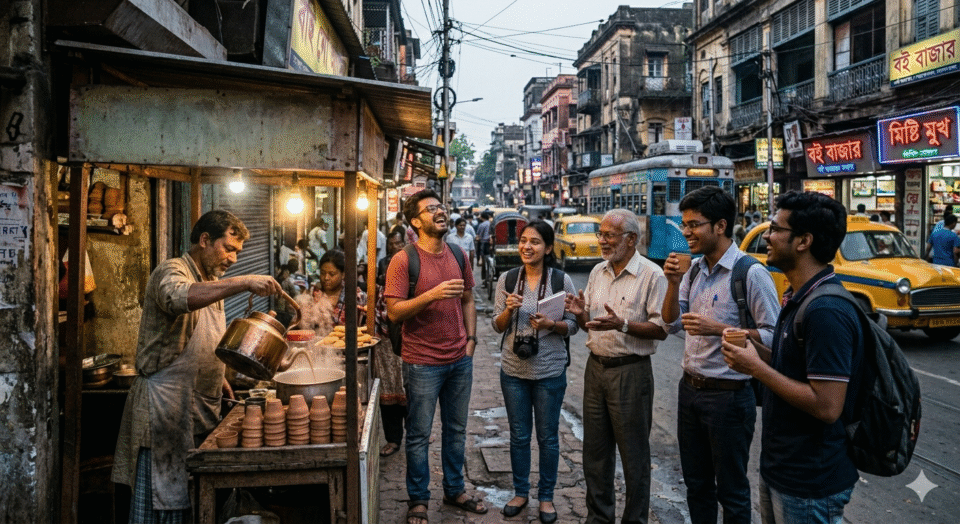
Picture this. It is 4:30 in the afternoon. The heat of the day has started to ease. Five or six people gather at a street-side tea stall. One is a college professor. Another repairs air conditioners for a living. A third is a retired government clerk. They order tea. Within minutes, someone brings up a topic, perhaps a recent cricket match, a new film, a political scandal, or a philosophical question about whether free will exists. The conversation flows without hierarchy. No one moderates. No one checks the time. The tea vendor refills cups as needed. An hour passes. People drift away and others join. The Adda continues.
This is not a romanticized description. This is daily life in Kolkata. I have witnessed it in North Kolkata, South Kolkata, Salt Lake, and Howrah. It happens in every neighborhood, at every income level, and across every generation. Adda is the social infrastructure of the city, and tea is its fuel.
The Historical Roots
Adda has deep roots in Bengali intellectual culture. In the 19th and early 20th centuries, Kolkata was the intellectual capital of India. The Bengali Renaissance produced writers, philosophers, scientists, and reformers who changed the country. Many of these thinkers gathered in salons and drawing rooms for extended discussions. As tea became more accessible to the general population in the mid-20th century, these conversations moved from the parlor to the pavement. The tea stall democratized Adda.
The transition matters because it removed the barriers of class and education. You did not need to be invited to a tea stall Adda. You just showed up, ordered a cup, and joined in. If your argument was good, you earned respect regardless of your background. This egalitarian spirit is central to why Adda endures.
View Our Chaiolic Products


Why Tea and Not Coffee?
This is a question I have been asked many times. Kolkata has coffee. The Indian Coffee House on College Street is one of the city’s most famous institutions. But tea dominates the Adda culture for practical reasons. Tea is cheaper, faster to prepare, and available at every street corner. A coffee costs more and is typically consumed indoors. Tea stalls are open-air, visible, and accessible. They invite participation in a way that enclosed coffee shops do not.
There is also a sensory argument. Tea, particularly the strong CTC variety brewed in Kolkata, is warming, slightly bitter, and stimulating. It keeps conversations going. Coffee, while also caffeinated, tends to be consumed more slowly and individually. Tea in Kolkata is communal by design. The vendor brews a batch, not individual cups. Everyone drinks the same tea at the same time. This shared experience reinforces the collective nature of Adda.
The Role of the Tea Vendor
The chai vendor, or “Chawallah,” is often an underappreciated participant in the Adda. A good vendor knows his regulars, remembers their preferences, and sometimes contributes to the conversation himself. He is part host, part bartender, part therapist. In many neighborhoods, the vendor is the most socially connected person on the block because he interacts with every demographic throughout the day.
Some vendors develop reputations not just for their tea but for the quality of conversation their stalls attract. People will walk an extra ten minutes to reach a stall known for lively Adda. The tea becomes a secondary draw. The primary attraction is the company.
Adda in the Digital Age
Has social media killed Adda? This is a common concern, and the answer is nuanced. Yes, younger generations in Kolkata spend time on their phones. Yes, WhatsApp groups and Twitter threads have created digital versions of Adda. But the physical tea stall Adda has not disappeared. If anything, digital conversations often reference or continue discussions that started at a tea stall.
What has changed is the pace. Older Addas could stretch for hours. Younger participants tend to be more time-constrained. But the core ritual remains: gather, order tea, talk, listen, argue, laugh, and leave feeling slightly more connected to the world than when you arrived.
Why This Matters for Tea Culture Globally
In most countries, tea or coffee consumption is a solitary or transactional act. You order, you drink, you leave. Kolkata’s Adda culture offers an alternative model where the beverage is a social catalyst. The tea is not the product. The conversation is the product. The tea simply makes it possible.
This is a powerful idea for anyone who cares about community, connection, and the role that simple rituals play in holding societies together. A five-rupee cup of tea and an hour of honest conversation may be worth more than any amount of screen time. Kolkata figured this out a long time ago. The rest of the world is still catching up.