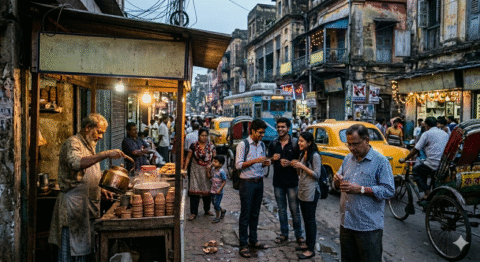
Kolkata has thousands of tea stalls. Literally thousands. But not all of them offer the same experience. Some are famous for the quality of their brew. Others are legendary because of their history, their atmosphere, or the conversations that happen around them. If you want to experience the real chai culture of Kolkata, not the tourist version but the version that locals live every day, here are five spots that deserve your attention.
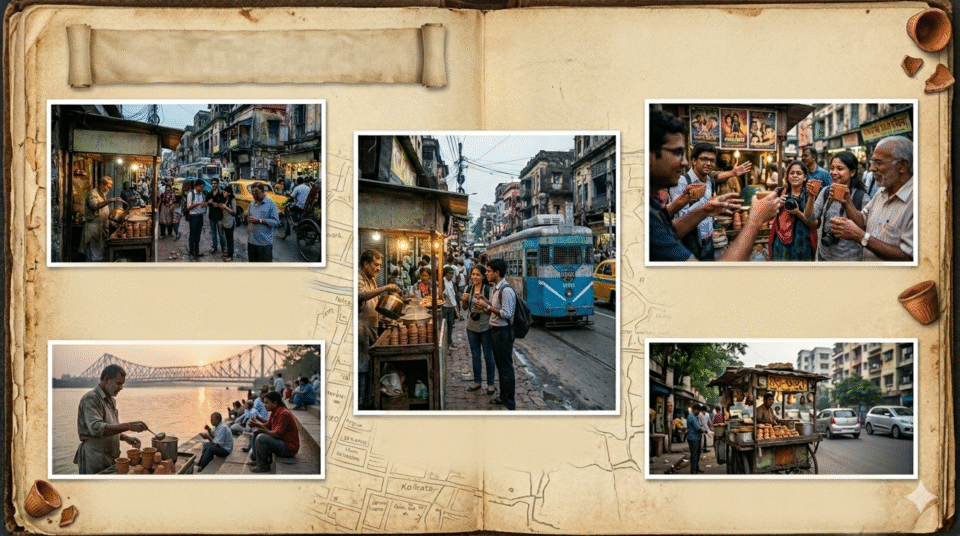
1. Indian Coffee House, College Street
The name is misleading. Yes, it serves coffee. But the Indian Coffee House on College Street is one of the most important tea-drinking spaces in Kolkata’s history. Located in the heart of the city’s academic district, this multi-story establishment has hosted some of Bengal’s greatest minds. Satyajit Ray, Amartya Sen, and Subhas Chandra Bose are among the names associated with its tables.
The tea here is basic. It is served in a standard cup, not a clay Bhar. The brew is light-to-medium strength with milk. Nothing fancy. But the experience is extraordinary. The ceiling fans creak, the waiters move in their distinctive white uniforms, and the conversations around you range from Marxist theory to football tactics. You come here not for the tea itself but for what the tea enables. A cup costs almost nothing, and it buys you a seat in a living piece of history.
2. Favourite Cabin, Surya Sen Street
Favourite Cabin is tiny. There are perhaps ten seats inside, all on wooden benches pushed against the walls. The space is cramped, the lighting is dim, and the ventilation is minimal. It is perfect. This is a classic North Kolkata “cabin,” a type of small eatery that has existed since the early 20th century.
The tea at Favourite Cabin is strong and well-made. They serve it with toast and butter or a plate of chops and cutlets. The regulars are mostly local residents who have been coming here for decades. Some were introduced by their fathers, who were introduced by their fathers. It is a generational relationship. As a visitor, you will be treated warmly, but the stall makes no effort to impress. It just delivers consistent, honest tea and lets the atmosphere do the rest.
View Our Chaiolic Products

3. Paramount Cold Drinks, College Street
Paramount is primarily known for its sherbets and cold drinks, but during winter and the cooler months, their hot tea becomes the main draw. The shop is a Kolkata institution, operating from a small storefront that has not changed much in appearance since it opened. The tea is served sweet, strong, and piping hot. What makes Paramount special is the crowd it attracts: students from nearby Presidency University and Calcutta University, booksellers from the surrounding stores, and the occasional professor escaping a departmental meeting.
The area around Paramount, along College Street, is home to the largest second-hand book market in the world. Browsing old books with a cup of strong tea in hand is one of the finest experiences Kolkata offers. It costs almost nothing and feels like a privilege.
4. Dolly’s Tea Stall, Dakshineshwar
Near the famous Dakshineshwar Kali Temple in North Kolkata, Dolly’s is a no-frills operation. A small stove, a few kettles, and clay cups. What elevates this stall is the ginger tea. Dolly’s uses an aggressive amount of fresh ginger, producing a brew that clears your sinuses and warms your entire body. After the sensory overload of the temple visit, with its bells, incense, and crowds, a cup of Dolly’s ginger chai feels like a reset.
The stall sits on the edge of the Hooghly River. You can drink your tea while watching the boats go by and the temple’s spires catch the afternoon light. It is one of those rare moments where the setting and the beverage combine into something greater than either could offer alone.
5. Any Tea Stall Under the Howrah Bridge
I am not naming a specific stall here because that would defeat the purpose. The area beneath and around the Howrah Bridge, on both the Howrah and Kolkata sides, is dense with tea vendors. Some have been there for decades. Others are newer. What they share is location: one of the most photographed bridges in the world, with the Hooghly River flowing beneath it and the noise of a million commuters overhead.
Drinking tea here is a multi-sensory assault. The sound of traffic, the smell of the river, the steam from the cup, the warmth of the clay. It is chaotic and beautiful. Do not look for the “best” stall. Just walk, follow your instincts, and stop where the crowd is thickest. Order a cup, stand by the railing, and watch the city move. This is Kolkata at its most authentic, and no curated cafe experience can match it.
What These Spots Have in Common
None of these places are luxurious. None of them have websites, reservation systems, or Instagram-worthy interiors. What they have is authenticity and consistency. They serve tea that tastes the way it tasted twenty years ago, to people who have been coming for just as long. They do not chase trends or cater to tourists. They simply exist, reliably and unpretentiously, as pillars of their neighborhoods.
If you visit all five, you will not just have tasted Kolkata’s tea. You will have experienced its social fabric, its intellectual tradition, its spiritual life, and its raw, unfiltered energy. That is what real chai culture looks like. It is not a product. It is a way of being.
8. The Soul of Kolkata: Why Bharer Chai is More Than Just a Drink
There are drinks and then there are rituals. A glass of wine at dinner is a drink. A martini at a bar is a drink. But Bharer Chai in Kolkata is something else entirely. It is a ritual so deeply embedded in the city’s identity that removing it would be like removing the Howrah Bridge or the yellow taxis. The city would still function, but it would lose something essential, something that makes it Kolkata.
What Is Bharer Chai, Exactly?
For those unfamiliar, Bharer Chai is tea served in a “Bhar,” an unglazed, hand-made clay cup. The cup is small, holding roughly 80 to 100 milliliters. The tea inside is strong CTC brew, dark as mahogany, mixed with boiled milk and sugar. The clay cup is single-use. After you finish, you drop it on the ground where it shatters and eventually returns to the soil.
That description covers the mechanics. But it does not capture the meaning. Bharer Chai is not about the tea alone. It is about the container, the setting, the company, and the moment. Every element matters, and together they create an experience that transcends the sum of its parts.
The Taste That Clay Creates
I have tasted the same tea poured into three different vessels: a glass, a ceramic mug, and a clay Bhar. The difference is not subtle. The clay version is smoother, less bitter, and carries a distinct earthen undertone that the other vessels cannot produce. This is because the unglazed clay is porous and mildly alkaline. It interacts with the acidic tea, softening its edges and adding mineral complexity.
There is also the aroma. When tea hits the Bhar, the heat releases a scent that Bengalis call “Sondhe Maatir Gondho,” the fragrance of earth after rain. It is a primal, comforting smell that triggers memory and emotion in a way that stainless steel or paper simply cannot. You are not just drinking tea. You are inhaling the earth.
The Potter’s Contribution
Behind every Bhar is a potter. On the banks of the Hooghly River, communities of artisans have been shaping these cups for generations. They use river silt, which is rich in minerals and ideal for fast-firing. A skilled potter can produce hundreds of cups in a day, and yet each one carries the slight imperfections of handcraft. No two Bhars are identical, which means no two tea experiences are identical either.
The firing process uses rice husks and wood, giving the cups their characteristic smoky, ash-grey finish. This process is carbon-neutral in practice. The raw material comes from the river, the fuel comes from agricultural waste, and the finished product returns to the earth after use. The environmental footprint is essentially zero.
Supporting Bharer Chai means supporting these potters. It means sustaining a decentralized, rural craft economy that employs thousands of families without requiring factories, machinery, or corporate infrastructure. In an era obsessed with scalability and efficiency, the Bhar is a reminder that some things work better at a human scale.
The Environmental Argument
We live in a world choking on plastic waste. Single-use plastic cups, plastic-lined paper cups, and polystyrene containers are environmental disasters. Kolkata’s Bhar offers a genuine alternative. It is biodegradable in the truest sense. It does not need to be collected, sorted, or processed. It breaks, crumbles, and dissolves back into the soil from which it came.
This is not theoretical sustainability. This is sustainability that has been practiced daily by millions of people for over a century. No recycling plants, no carbon offset schemes, no greenwashing. Just clay, fire, tea, and earth. The simplicity of the system is its genius.
The Social Dimension
Bharer Chai is also a social equalizer. At a chai stall in Kolkata, the businessman and the bus driver hold the same cup. Neither gets a bigger serving or a better vessel. The tea is identical. The experience is identical. In a deeply stratified society, this matters more than most people realize.
The tea stall is one of the few truly democratic spaces in Indian public life. Your caste, your income, your education, and your political affiliation are irrelevant. You are a person holding a clay cup, and that is enough. This leveling effect is why Bharer Chai is not just a cultural curiosity. It is a social institution.
Why It Has Survived
When multinational coffee chains entered India, many predicted the death of street chai. In Delhi and Mumbai, that prediction partly came true. Starbucks and its competitors carved out significant market share. But in Kolkata, the story unfolded differently. The city did not reject modernity. It simply refused to abandon what worked.
Kolkata has coffee shops. It has bubble tea outlets and matcha bars. But the Bharer Chai stall remains the dominant tea experience. This is not nostalgia or stubbornness. It is a clear-eyed judgment by millions of people that this particular product, in this particular format, is superior to the alternatives. The clay cup is not a relic. It is a choice.
What Bharer Chai Represents
At its core, Bharer Chai represents a philosophy of living that values authenticity over convenience, community over isolation, and sustainability over disposability. It is a drink that forces you to slow down because the cup is too hot to gulp. It is a drink that connects you to the earth because you can taste and smell the clay. It is a drink that connects you to other people because the stall is a gathering point.
In a world that moves too fast, consumes too much, and discards too easily, Bharer Chai is a quiet act of resistance. It says that some things should not be optimized, streamlined, or disrupted. Some things should simply be preserved, enjoyed, and passed on.
Kolkata understands this. The rest of the world is still learning.